CAD Guardian helps engineering and manufacturing teams automate CAD work, connect technical systems, and make critical delivery workflows easier to own.
Loading page
PDM, PLM, and Autodesk Vault
Make engineering data easier to find, release, change, and trust.
CAD Guardian improves Vault, PDM, and PLM workflows across lifecycle state, metadata, revision, approval, release, migration, and connected business systems.
Parts, assemblies, drawings, documents, BOMs, and change records
Controls
Metadata, lifecycle, revision, approval, permission, and release
starting point
One product family, document class, or lifecycle segment
Handoff
State model, field dictionary, risk list, and pilot backlog
Implementation model01 / 01
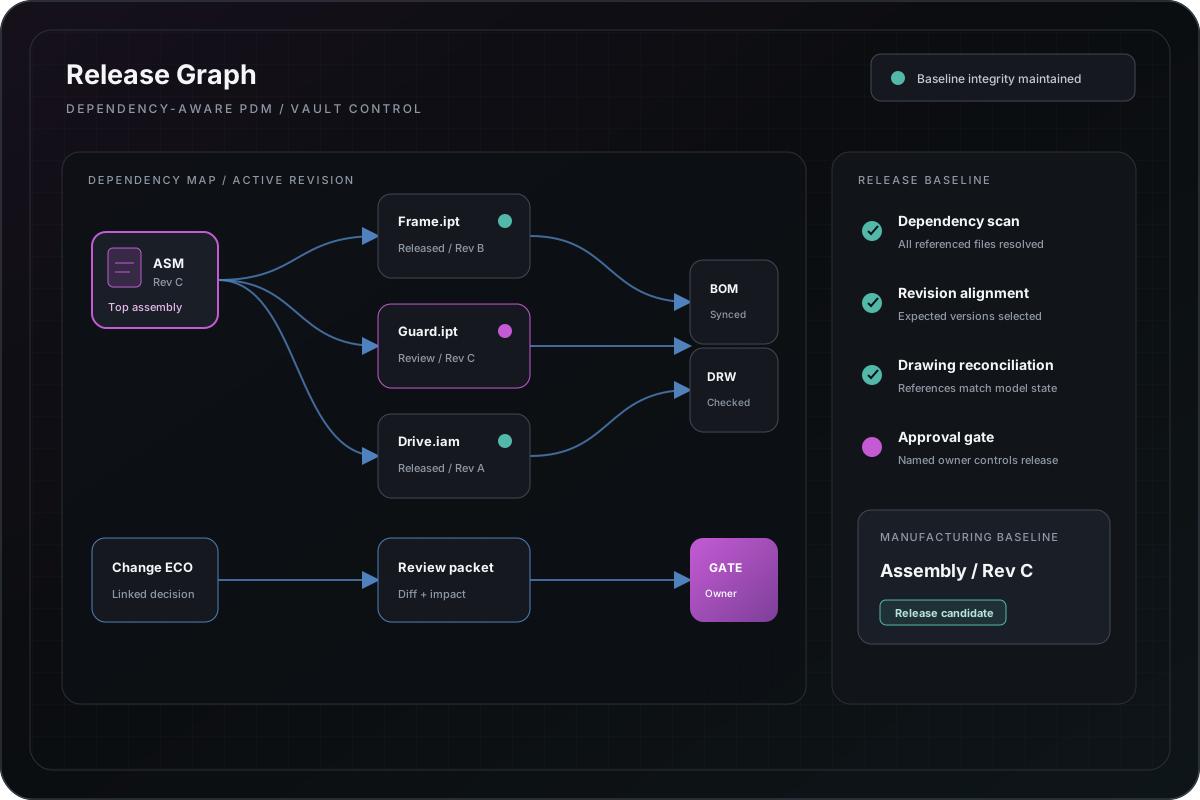
Implementation diagramVault and PDM release graph
Lifecycle automation is framed as an owned state-and-evidence system, not a hidden sequence of file operations.
Operating problem
File chaos is usually an ownership problem before it is a platform problem.
Duplicate files, broken references, uncertain revisions, missing metadata, and inconsistent approvals create release risk. Buying or migrating a platform before those rules are visible can preserve the confusion in a more expensive system.
Unclear source of truth across folders, PDM, PLM, ERP, and document systems
Lifecycle states that do not match actual engineering work
Metadata fields with no accountable owner
Release, change, and approval paths that rely on manual interpretation
Migration pressure without a representative validation set
Service scope
Model the records, decisions, and transitions the platform must support.
Current and target lifecycle states
Metadata and field ownership
Revision, approval, release, and change boundaries
File references, document classes, and BOM relationships
Permissions, integrations, jobs, and downstream handoffs
Migration containment, cleanup, and pilot strategy
Deliverables
Governance and technical artifacts tied to representative records.
Lifecycle
State and transition model
Metadata
Field dictionary and ownership matrix
Migration
Risk, exception, and containment report
Pilot
Product-family or document-class backlog
Delivery process
Walk real records through the proposed control model.
01 — Inventory one representative record and release path.
02 — Identify state, metadata, permission, and ownership gaps.
03 — Design the minimum viable lifecycle and integration boundary.
04 — Validate representative files and exceptions against the model.
05 — Plan cleanup, migration, configuration, or automation in contained slices.
Relevant implementation
Readiness evidence is separated from unsupported production claims.
public demonstrations can demonstrate fixture checks, metadata readiness, reference analysis, and API boundaries. Native Vault, PDM, or PLM configuration and state changes require the supported environment and customer-specific controls.
Start with the smallest lifecycle boundary that can be judged honestly.
Vault or PDM workflow redesign
Metadata and lifecycle cleanup
Migration readiness and exception analysis
Job processing, integration, and release automation
Document-control and source-of-truth clarification
Related implementation stories
See how the approach changed real operating work.
Start with the business pressure and result, then open the technical appendix when your team needs implementation depth.
Engineering systems implementationManufacturing
Turn quoting into a governed path from RFQ intake to engineering handoff.
The problem was not simply replacing Excel. The useful rules and operator knowledge had to survive while request quality, configuration state, documents, status, and responsibility became easier to inspect.
Bring one product family, document class, or release path.
Name the current systems, states, metadata, failure modes, representative records available later, and the lifecycle decision that must become clearer.