CAD Guardian helps engineering and manufacturing teams automate CAD work, connect technical systems, and make critical delivery workflows easier to own.
Loading page
Mechanical design platform
Drive Inventor models, drawings, BOMs, and release packages from trusted inputs.
CAD Guardian automates and modernizes Inventor work across parameters, iProperties, assemblies, drawings, BOMs, iLogic, exports, and Vault-aware release workflows.
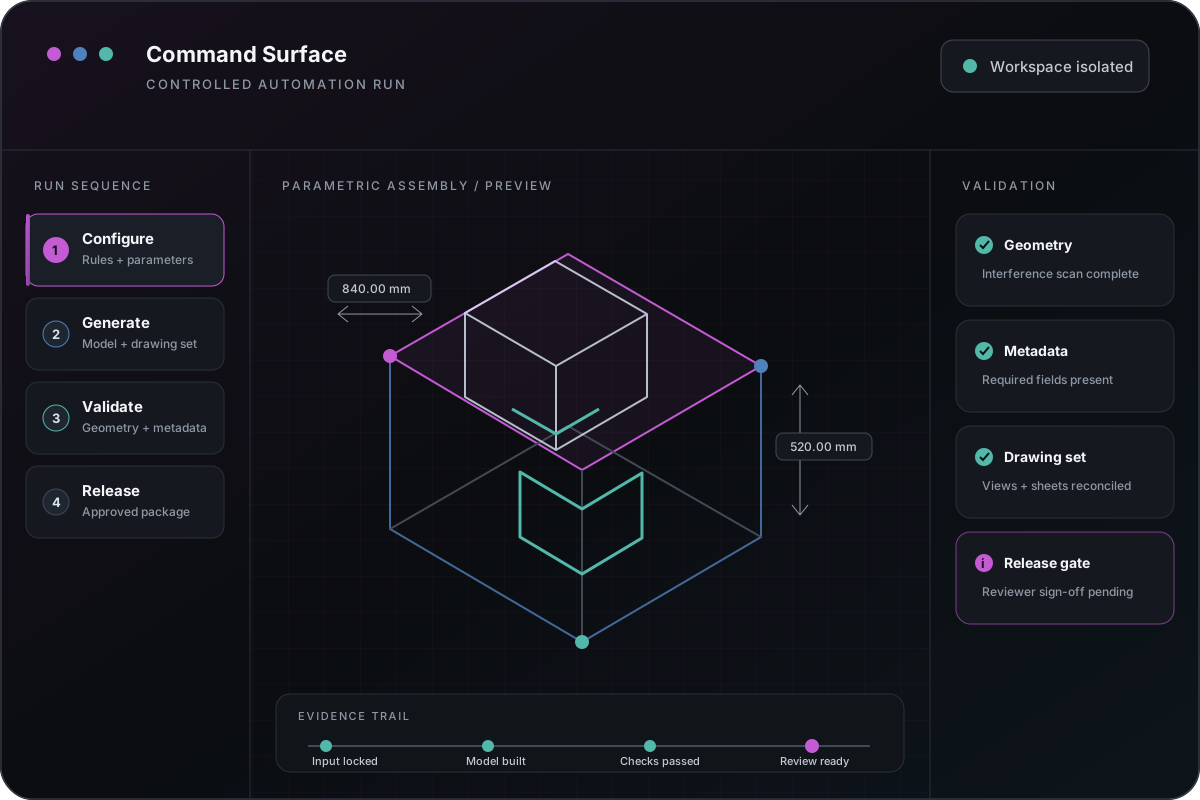
A representative operating model for keeping commands, rules, exceptions, review, and release evidence visible.
Platform fit
Best when product rules and accepted output can be made explicit.
Inventor automation is most defensible when model parameters, assembly relationships, drawing expectations, BOM rules, and exceptions can be reviewed against representative product data.
Parameterized parts, assemblies, product families, and configuration logic
Repeated drawing, view, annotation, property, and export work
BOM extraction, normalization, comparison, and downstream handoff
iLogic, VBA, scripts, or add-ins that need modernization
Capabilities
Automate the product-data path, not only the model command.
Inventor API and C#/.NET add-in development
Parameter, iProperty, occurrence, drawing, view, and BOM automation
iLogic assessment, containment, migration, and controlled replacement
Batch generation, exports, package manifests, validation, and exception reports
Desktop interfaces, diagnostics, deployment, and operator guidance
Integration
Inventor often sits inside a broader product-data workflow.
Autodesk Vault lifecycle, metadata, jobs, and release integration
ERP, estimating, configuration, document, and reporting handoff
Excel, SQL, APIs, files, and controlled product-record imports
Drawing, PDF, STEP, DXF, BOM, and production-package outputs
Modernization
Move trusted Inventor behavior into a supportable architecture.
01 — Inventory models, rules, templates, references, and external dependencies.
02 — Capture accepted model, drawing, BOM, and package examples.
03 — Separate product rules, CAD operations, integration, UI, and logging.
04 — Validate target-version and Vault-context behavior.
05 — Release with deployment, rollback, known limits, and support ownership.
Relevant implementation
Evidence focuses on deterministic product and package behavior.
Public evidence can show architecture, generalized configuration patterns, output contracts, and validation design. Native product data remains inside a controlled review boundary.
Representative assemblies and dependencies determine what can be proven.
Inventor automation depends on release version, templates, libraries, references, Content Center, add-ins, and data-management context. Public fixtures cannot establish production parity for private product families.
Large assemblies, adaptive behavior, derived components, and custom content require targeted testing
Vault state and permissions can change how an otherwise correct add-in behaves
Generated models and drawings still require accountable engineering review
Next step
Bring the Autodesk Inventor workflow that needs to move faster and release reliably.
Name the current workflow, accepted output, platform version, dependencies, known failure cases, and the first decision the engagement should resolve.