CAD Guardian helps engineering and manufacturing teams automate CAD work, connect technical systems, and make critical delivery workflows easier to own.
Loading page
Drawing and document automation
Produce complete drawing and document packages with less manual assembly.
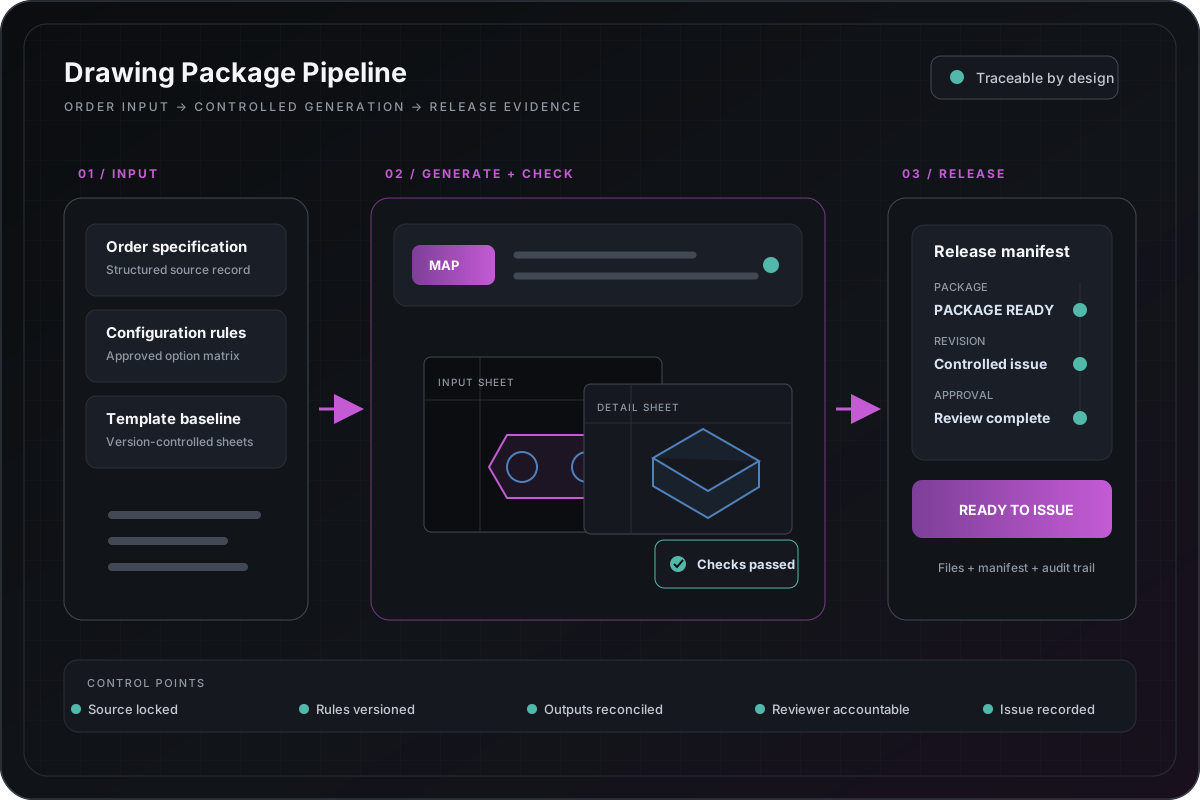
CAD Guardian helps teams define package contents, naming, metadata, revisions, exports, exception reporting, and review gates before automating document production.
A bounded package flow makes accepted inputs, deterministic rules, review gates, and released artifacts inspectable.
Operating problem
A package can look complete while still being operationally wrong.
Teams often rely on manual knowledge to decide which drawings, exports, reports, metadata, and transmittal details belong in a release. Automation should expose those rules rather than reproduce incomplete packages faster.
Missing or stale drawings and exports
Inconsistent naming, revision, folder, or transmittal rules
Manual PDF, DXF, report, and manifest assembly
Review state that is disconnected from package contents
No structured exception report or manual fallback
Service scope
Define the package as a verifiable output contract.
Required and conditional artifacts
Naming, revision, metadata, and folder rules
CAD export and generated-document behavior
Reference, completeness, and status checks
Manifest, transmittal, and exception reporting
Review, release, rollback, and manual fallback
Deliverables
A package workflow that can be reviewed before it scales.
Contract
Expected package manifest and conditional rules
Automation
Focused generation or assembly slice
Validation
Completeness, naming, revision, and exception checks
Operations
Reviewer instructions and fallback path
Delivery process
Compare the automated package with accepted examples.
01 — Select one repeated package or document class.
02 — Inventory required outputs, rules, and review ownership.
03 — Build the smallest generation and validation path.
04 — Compare the result with accepted packages and exceptions.
05 — Document release, fallback, support, and next expansion scope.
Relevant implementation
The case pattern focuses on output trust and handoff readiness.
The public case study describes a generalized drawing-package workflow, validation rules, and pilot boundary. Protected drawings, title blocks, customer information, and proprietary standards are not published.
Convert assembly state into classified BOMs, DXFs, labels, and release-ready packets.
Production preparation required the same assembly state to be interpreted separately for BOMs, flat patterns, DXFs, labels, lists, and package collection.
Bring one accepted package and one known exception.
Describe the source files, required outputs, naming and revision rules, downstream reviewer, known failure cases, and examples available later for private review.