Engineering operations
The CAD Guardian Delivery Operating Model
A reusable SOW to PR to acceptance to closeout system for CAD automation, engineering data, AI-assisted delivery, and runtime UAT.
ContentsJump sections
Why this matters
This CAD Guardian article now lives inside TSmithCode.ai so recruiters, engineering leaders, and consulting buyers can evaluate Thomas Smith's public technical thinking without depending on Framer.
CAD automation work does not fail only because the code is hard.
It fails because discovery, scope, pull requests, runtime proof, acceptance, handoff, and closeout are treated like separate conversations instead of one delivery system.
The CAD Guardian delivery operating model is the system I use to remove that ambiguity. It turns CAD automation, engineering data, AI-assisted delivery, and runtime UAT into a repeatable path from SOW to PR to acceptance to closeout.
Direct answer: the CAD Guardian delivery operating model is a public-safe engagement system that defines how work is discovered, planned, built, proven, handed off, and closed so the client can accept the result or issue a precise punch list.
Why CAD automation needs an operating model
CAD and engineering software work has more hidden risk than a normal web feature. The code often touches drawings, BOMs, file naming, Vault states, revision history, model metadata, shop-floor handoff, and the habits of people who have kept the operation moving for years.
A vague delivery process creates predictable failure modes: scope drifts, acceptance criteria move, screenshots replace evidence, review branches grow too large, and the final conversation becomes emotional because nobody can point to the exact decision being requested.
The operating model fixes that by making every stage produce a reviewable artifact. The client is never asked to accept effort. The client is asked to accept evidence.
The six delivery stages
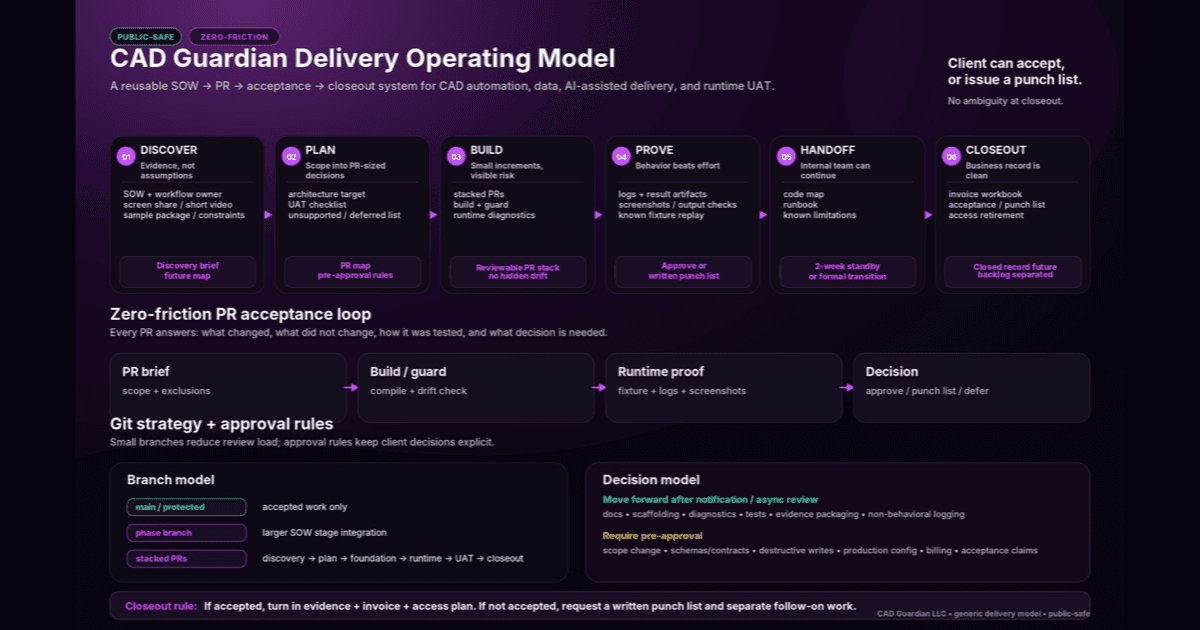
The model moves through six stages: discover, plan, build, prove, handoff, and closeout. Each stage has a small output that keeps the next stage honest.
- Discover: collect evidence instead of assumptions. The useful inputs are a SOW, workflow owner screen share, short video, sample package, constraints, and the current pain point.
- Plan: translate scope into PR-sized decisions. The output is an architecture target, UAT checklist, and supported or deferred list.
- Build: ship small increments with visible risk. The output is a stacked PR path, build evidence, guard checks, and runtime diagnostics.
- Prove: attach behavior evidence to the work. Logs, screenshots, output checks, and known fixture replay matter more than narrative confidence.
- Handoff: leave the internal team able to continue. The output is a code map, runbook, known limitations, and transition plan.
- Closeout: separate accepted work from future backlog. The final record is clean: invoice workbook, acceptance or punch list, and access retirement.
The zero-friction PR acceptance loop
Every meaningful pull request should answer four questions before the reviewer has to ask them.
- What changed?
- What did not change?
- How was it tested?
- What decision is needed now?
That turns PR review from a trust exercise into a decision loop. The PR brief states scope and exclusions. The build or guard step proves the code compiles and the checks ran. Runtime proof shows fixtures, logs, screenshots, or output artifacts. The decision block asks for approve, punch list, or defer.
This is especially important for CAD automation because the visible UI is rarely the whole system. A drawing export can look fine while metadata is wrong. A model update can pass once and fail on a different product family. Runtime proof keeps the review tied to behavior, not vibes.
Branch strategy and approval rules
Small branches reduce review load. Explicit approval rules reduce business ambiguity.
The branch model is simple: main is protected and contains accepted work only, phase branches hold larger SOW-stage integration, and stacked PRs move discovery to plan to foundation to runtime to UAT to closeout without hiding drift.
The decision model separates work that can move forward after notification from work that requires pre-approval.
- Move forward after notification or async review: docs, scaffolding, diagnostics, tests, evidence packaging, and non-behavioral logging.
- Require pre-approval: scope change, schemas and contracts, destructive writes, production configuration, billing impact, or acceptance claims.
That boundary protects both sides. The client does not become a bottleneck for harmless setup work, and CAD Guardian does not silently cross into business decisions that deserve explicit approval.
What a client can accept
The goal of this model is not ceremony. The goal is a clean acceptance record.
At closeout, the client should be able to say one of two things: accepted, or not accepted with a written punch list. Anything else is too ambiguous to invoice against, too ambiguous to hand off, and too ambiguous to turn into future backlog.
If accepted, the closeout package should include evidence, invoice workbook, and access plan. If not accepted, the response should identify the punch list and separate follow-on work from the original scope.
Where this model fits
This model fits CAD automation and engineering systems work where the risk is not only technical implementation but operational adoption. It is useful for Autodesk Inventor and Vault automation, drawing package workflows, metadata cleanup, .NET add-ins, internal engineering tools, runtime diagnostics, and AI-assisted delivery that still needs human acceptance.
It is also public-safe. The model explains how delivery is controlled without exposing client files, private drawings, internal systems, or proprietary data. That matters because good proof should increase trust without creating a confidentiality problem.
The real standard
A professional delivery system should make the final conversation boring.
No mystery. No vague status. No heroic summary. Just the scope, the evidence, the known limitations, the handoff path, and the decision in front of the client.
That is the CAD Guardian standard: evidence over assumptions, small reviewable increments, explicit decisions, and a closeout record clean enough for the client to accept or challenge without drama.
Related reading