
Founder-led engineering software consulting · CAD Guardian LLC

A controlled first move for Autodesk and .NET systems that cannot fail casually.

One accountable senior operator maps the operating risk, proves the smallest valuable change, and leaves your team with client-owned evidence and a clear build, narrow, pause, or stop decision.

Forward this when: a trusted engineering workflow needs a safer first move before leadership funds a broad transformation.

System boundary diagram showing buyer-owned systems and data, a controlled diagnostic boundary, and client-owned accepted outputs

Public synthetic diagram · Your systems stay buyer-controlled. The engagement produces reviewable, client-owned decision evidence before implementation authority expands.

Start with the operating problem

See your failure mode before you see a work history.

Choose the closest current risk. Each route points to proof and a bounded first decision—not an open-ended transformation program.

01

Autodesk release and automation risk

A trusted add-in, export, or CAD workflow works today—but the next release has no safe owner.

Review the evidence boundary
04

Data and integration trust

Exports, corrections, and exceptions move between systems without a reviewable source-of-truth contract.

Review the evidence boundary
05

CAD platform parity

A cross-platform request is being treated like a rewrite when acceptance and runtime evidence are the real risks.

Review the evidence boundary
06

Drawing, document, and PDM/PLM ownership

The drawing package is produced, but standards, revisions, handoff evidence, and ownership remain ambiguous.

Review the evidence boundary

The first funded decision

Buy clarity before you buy implementation.

An engineering or manufacturing team needs a controlled decision before funding quote, CAD, data, document, or workflow automation.

Before, controlled intervention, and accepted output flow for the Quote/RFQ Workflow Diagnostic

Public synthetic process model · No customer environment or result is represented.

Fixed price$4,500
DurationOne business week after kickoff and agreed inputs
Meeting burdenKickoff plus one decision review; asynchronous evidence review in between.

Buyer inputs

  • A non-sensitive workflow narrative and current output example
  • Relevant platform and software versions
  • Roles, reviewers, known failure cases, and the required accepted output
  • Redacted screenshots or field lists only when they are safe to share

Delivered

  • Current-state workflow and ownership map
  • Accepted-output definition and exception boundary
  • Source-of-truth and runtime dependency map
  • Validation, release, and evidence gates
  • Decision memo: build, narrow, pause, stop, or collect missing evidence
Acceptance criteria and exclusions

Accepted when

  • The target workflow, users, reviewers, and accepted output are explicit.
  • System-of-record, runtime, data, and ownership boundaries are reviewable.
  • The smallest safe next slice has validation evidence and a named decision owner.
  • Leadership can choose build, narrow, pause, or stop without buying another discovery loop.

Outside this diagnostic

  • Production code, deployment, data migration, or broad platform implementation
  • Security certification, legal review, or handling of CUI/export-controlled material
  • All-environment compatibility, 24/7 support, warranty, or staff augmentation
Data boundary

Start with synthetic, redacted, or non-sensitive material. Customer files, credentials, CUI, export-controlled data, and confidential source do not belong in public or unapproved tools.

Evidence with boundaries

Proof is labeled by strength—not flattened into one confident story.

Public records stay synthetic, sanitized, or generalized unless stronger use is explicitly permitted. A label describes evidence availability, not a customer endorsement.

Evidence record 01

Autodesk automation release boundary

Public synthetic proof
Buyer problem
A useful CAD automation path has become difficult to release, support, or transfer safely.
Business stakes
A failed update can interrupt engineering output, corrupt confidence in automation, or force manual recovery.
Constraints
Version-sensitive APIs, desktop runtimes, trusted user behavior, limited test fixtures, and confidential production files.
Controlled intervention
Separate platform-specific behavior from the acceptance contract; define fixtures, validation evidence, rollback, and ownership before expanding scope.
Evidence produced
Public synthetic Autodesk proof kits show inspectable code, validation patterns, and release-oriented artifacts without customer data.
Observable outcome
A reviewer can see what must be true before release and which evidence is still missing. No customer result or production deployment is implied.
Outside scope
Customer CAD files, production credentials, private source, deployment approval, and platform-wide migration.
Relevant first engagement
Quote/RFQ Workflow Diagnostic when the automation affects estimating, CAD output, or the quote-to-production handoff.
Evidence record 02

Quote/RFQ accepted-output boundary

Public synthetic proof
Buyer problem
Inputs, calculations, approvals, CAD context, and final quote output cross several owners without one acceptance definition.
Business stakes
Quote delay, repeated entry, correction loops, unclear margin assumptions, and production handoff ambiguity.
Constraints
Different systems of record, exception-heavy rules, sensitive commercial data, and reviewers who need evidence—not a black box.
Controlled intervention
Map the current workflow, name the accepted output, trace calculation and approval ownership, then isolate the smallest testable automation slice.
Evidence produced
A synthetic before/intervention/accepted-output model and diagnostic artifact list make the decision path reviewable.
Observable outcome
The buyer can decide whether to blueprint, prototype, implement, or stop before production code is authorized.
Outside scope
Pricing-policy decisions, live quote records, ERP changes, payment processing, and implementation code.
Relevant first engagement
Quote/RFQ Workflow Diagnostic — $4,500.
Evidence record 03

Legacy .NET parity-first modernization

Generalized due to confidentiality
Buyer problem
A mature desktop or web application carries critical behavior that is poorly documented and risky to rewrite.
Business stakes
Release hesitation, unsupported dependencies, identity and licensing risk, and loss of trusted user behavior.
Constraints
Legacy frameworks, hidden business rules, limited regression coverage, operational continuity, and unclear support ownership.
Controlled intervention
Inventory current behavior, protect identity and data boundaries, move one contained slice, verify parity, and preserve rollback.
Evidence produced
The public description is generalized. Qualification can establish whether sanitized architecture or acceptance evidence is appropriate to review.
Observable outcome
Modernization becomes a sequence of evidence-backed decisions instead of an all-or-nothing rewrite claim.
Outside scope
Named-customer details, private repositories, licensing commitments, or claims of production results without approval.
Relevant first engagement
A bounded diagnostic to define the first parity slice and its acceptance evidence.
Evidence record 04

Data and integration trust boundary

Private review after qualification
Buyer problem
Operational data moves through exports, APIs, reports, and manual correction without explicit validation or ownership.
Business stakes
Reporting corrections, exception queues, duplicated truth, and downstream decisions based on unclear data contracts.
Constraints
Multiple source systems, partial records, retry behavior, audit needs, and sensitive operational data.
Controlled intervention
Name the source of truth, validation rules, rejected-record path, receipts, retry behavior, consumers, and support owner.
Evidence produced
Public-safe architecture patterns demonstrate the boundary. Environment-specific evidence remains qualification-gated.
Observable outcome
Exceptions and ownership become visible enough to scope one safe integration or reporting correction slice.
Outside scope
Live customer records, production API credentials, compliance certification, and unapproved external data processing.
Relevant first engagement
A diagnostic when data trust is blocking an engineering, quote, CAD, or document workflow decision.

Founder-level attention without founder-level dependency

Continuity is designed into the artifacts.

Founder-led, AI-accelerated, human-accountable delivery keeps senior context close while making the work transferable. AI assists throughput; Thomas remains accountable for decisions, review, and release evidence.
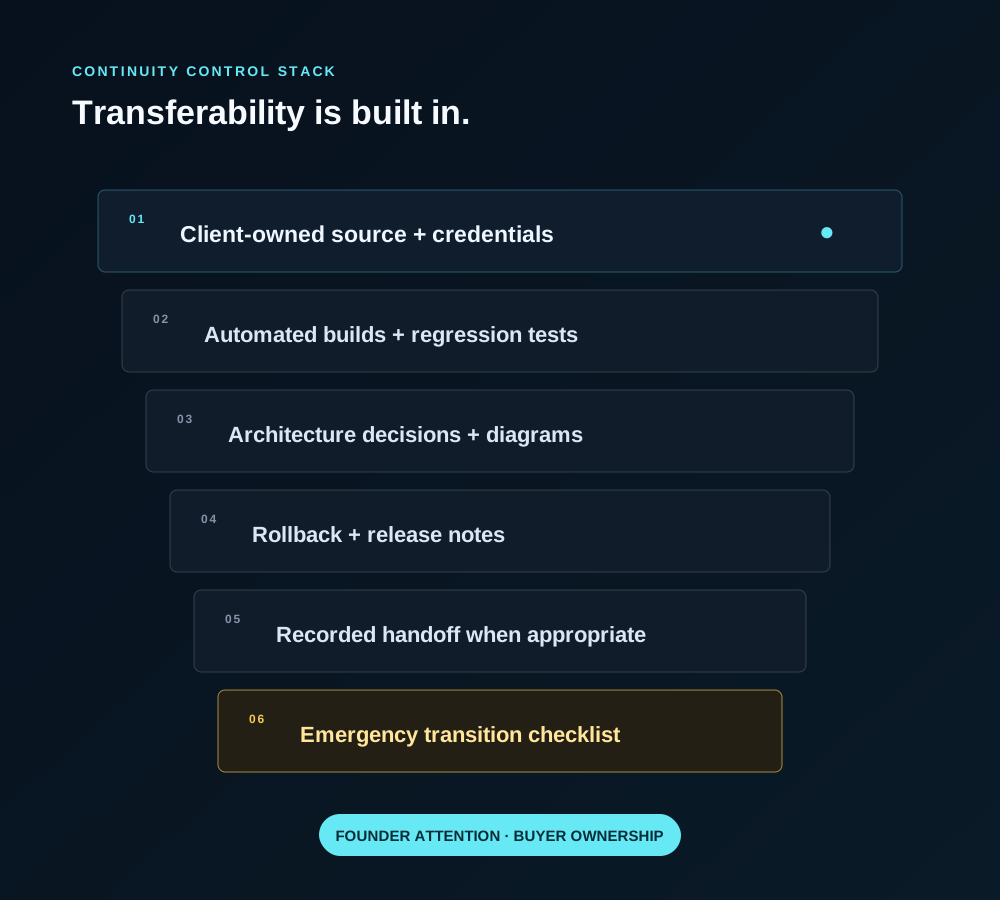
  • Client-owned repositories and client-controlled production credentials
  • Weekly source, test, documentation, and decision checkpoints
  • Automated builds, regression tests, and acceptance evidence
  • Architecture decision records plus current-state and target-state diagrams
  • Rollback instructions, release notes, and an emergency transition checklist
  • Recorded handoff walkthroughs when appropriate and approved
  • Documented support boundaries; specialist escalation only with buyer approval
  • Capacity policy: no more than two active implementation builds at one time
Client-owned continuity stack showing source, tests, decisions, diagrams, rollback, release notes, and handoff

Public synthetic artifact model · Buyer ownership remains the control point.

Choose the right delivery model

Small should mean focused—not fragile or falsely scaled.

A large provider is the safer choice for many simultaneous teams, broad geographic rollout, large classroom training, software resale, or continuously staffed support. A founder-led specialist is the higher-value choice when the first decision needs direct senior access, cross-domain diagnosis, low coordination drag, and a safe stop point.

Decision factorCAD Guardian / TSmithCodeLarger provider
Senior accessThe person diagnosing the risk is accountable for the delivery path.A broader bench may provide more roles, escalation layers, and geographic coverage.
First purchaseA bounded decision with explicit stop criteria before a broad program.A larger assessment may fit multi-site or multi-workstream transformation planning.
CapacityDeliberately limited concurrent builds; no silent handoff to junior staff.Safer when many teams, classrooms, regions, or parallel workstreams must move at once.
ContinuityClient-owned code, tests, diagrams, decision records, rollback, and handoff checkpoints.Organizational redundancy and staffed support may be preferable when continuous coverage is mandatory.

Fund only the next justified step

The offer ladder preserves a decision at every boundary.

01

Quote/RFQ Workflow Diagnostic

$4,500

Should we build, narrow, pause, or stop?

02

RFQ System Blueprint

$7,500

What should be built, owned, validated, and handed off?

03

Quote Automation Prototype

$15,000

Can the riskiest assumption be proven safely?

04

Implementation Build Slice

$25,000–$75,000

Can one accepted production slice be delivered and transferred?

05

Drawing/Document Automation Slice

$12,500–$35,000

Can one governed output path be automated and accepted?

06

Monthly retainers

$3,500 / $7,500 / $12,500

What bounded support or iteration capacity is justified?

Prices shown are public offer values, not a proposal or contract. Scope, availability, and terms are confirmed before commitment.

Prepare a fixed-scope request

Route the decision without donating a discovery workshop.

Select only high-level, non-sensitive facts. The next route preserves your intent and prepares a bounded diagnostic request; it does not submit a payment, contract, project file, or confidential record.

  1. Routing fit is checked.
  2. Scope and data boundaries are confirmed.
  3. A fixed-scope diagnostic request is prepared.
  4. Implementation is discussed only after the decision evidence exists.
Add qualification details

No charge is created here. Commercial scope and terms require confirmation through the approved path.

Different decision, separate lane

Evaluating Thomas for a W-2 role or technical screen?

This consulting page is purchase-first. Employment chronology, résumé evidence, and recruiter routing stay separate so neither decision is diluted.