Article
Mar 19, 2026
The New Engineering Stack Replacing Manual QA (CLI Agents, Playwright MCP, CI/CD Automation)
Manual QA is becoming obsolete. Modern engineers are using CLI-driven workflows, Playwright automation, and MCP-powered AI agents to enforce quality at every commit. This guide breaks down the exact stack replacing traditional testing and how to integrate E2E, regression, and UI validation into CI/CD pipelines for faster, safer deployments. Most teams are still working like its 2015!
🚀 The New Engineering Stack Replacing Manual QA
CLI Agents, Playwright MCP, and the Rise of Deterministic Software Delivery
🧨 Most Engineers Are Already Behind (Whether They Know It or Not)
Most teams today are still shipping software like this:
Write feature
Click through UI manually
Maybe run a few unit tests
Deploy
Hope nothing breaks
This is not engineering.
This is controlled risk with delayed feedback.
Meanwhile, a new workflow has already emerged—quietly replacing this model in high-performing teams:
CLI-driven development
AI-assisted implementation with persistent context
Full UI behavior validation using Playwright
CI/CD pipelines that enforce correctness automatically
If you are not operating in this model yet, you are not competing on the same field.
🧠 Context: What Actually Changed
This shift did not happen because of one tool.
It happened because three layers converged:
1. CLI Became the System Interface
Not just a tool—the control plane
2. Playwright Made UI Behavior Testable
No more blind spots between logic and user experience
3. MCP Enabled Persistent AI Context
AI is no longer stateless—it understands your system
⚙️ The Old Model vs The New Model
❌ Legacy Workflow (Still Common)
IDE-centric
Manual UI validation
Unit-test heavy, E2E-light
CI/CD optional or weakly enforced
Bugs discovered post-deployment
✅ Modern Workflow (Already Winning)
CLI-first orchestration
AI-assisted development with context
Playwright-driven E2E + UI validation
CI/CD as enforcement (not suggestion)
Failures caught before deployment
🚨 If Your Workflow Looks Like This…
Be direct with yourself:
You manually test UI before release
Your CI/CD does not block broken UI flows
Your tests don’t simulate real user behavior
You rely on QA cycles instead of system enforcement
You fix issues after users report them
👉 Then your system is reactive, not engineered.
🧬 The New Engineering Loop (Non-Negotiable)
This is the loop replacing traditional development:
Code is written (often AI-assisted)
Context-aware agents understand system intent
Playwright tests validate real user workflows
CI/CD enforces pass/fail conditions
Deployment proceeds automatically—or is blocked
👉 No ambiguity
👉 No guesswork
👉 No “it worked on my machine”
🎭 Playwright: The End of UI Blindness
Historically, UI has been the weakest layer:
Hard to test
Easy to break
Expensive to validate manually
Playwright changes that.
What It Enables:
Real browser automation (Chromium, WebKit, Firefox)
Deterministic user flow simulation
Visual + behavioral validation
Network-level inspection
Cross-environment consistency
🔥 Example Capabilities
Validate login flows across environments
Ensure form submissions behave correctly
Detect UI regressions instantly
Confirm state changes after user actions
Capture screenshots/videos on failure
💡 Strategic Impact
Playwright doesn’t just test UI.
It:
Defines expected behavior
Enforces product integrity
Becomes a gatekeeper for deployment
🧠 MCP (Model Context Protocol): The Missing Piece
Most developers are still using AI like this:
Ask → Get answer → Copy/paste
That’s not what’s happening anymore.
MCP Enables:
Persistent memory across sessions
Deep understanding of your codebase
Multi-step reasoning tied to real files
Context-aware refactoring and generation
⚡ What This Means Practically
AI can now:
Update tests when features change
Understand relationships between components
Suggest architecture improvements
Maintain consistency across modules
👉 This is not autocomplete
👉 This is co-development
⚡ What Most Developers Still Don’t Realize
Playwright + MCP + CLI Agents together enable:
👉 Self-Healing Systems
Where:
Tests adapt as UI evolves
Failures explain root cause
Fixes are suggested automatically
Systems become increasingly stable over time
This is the direction of software engineering.
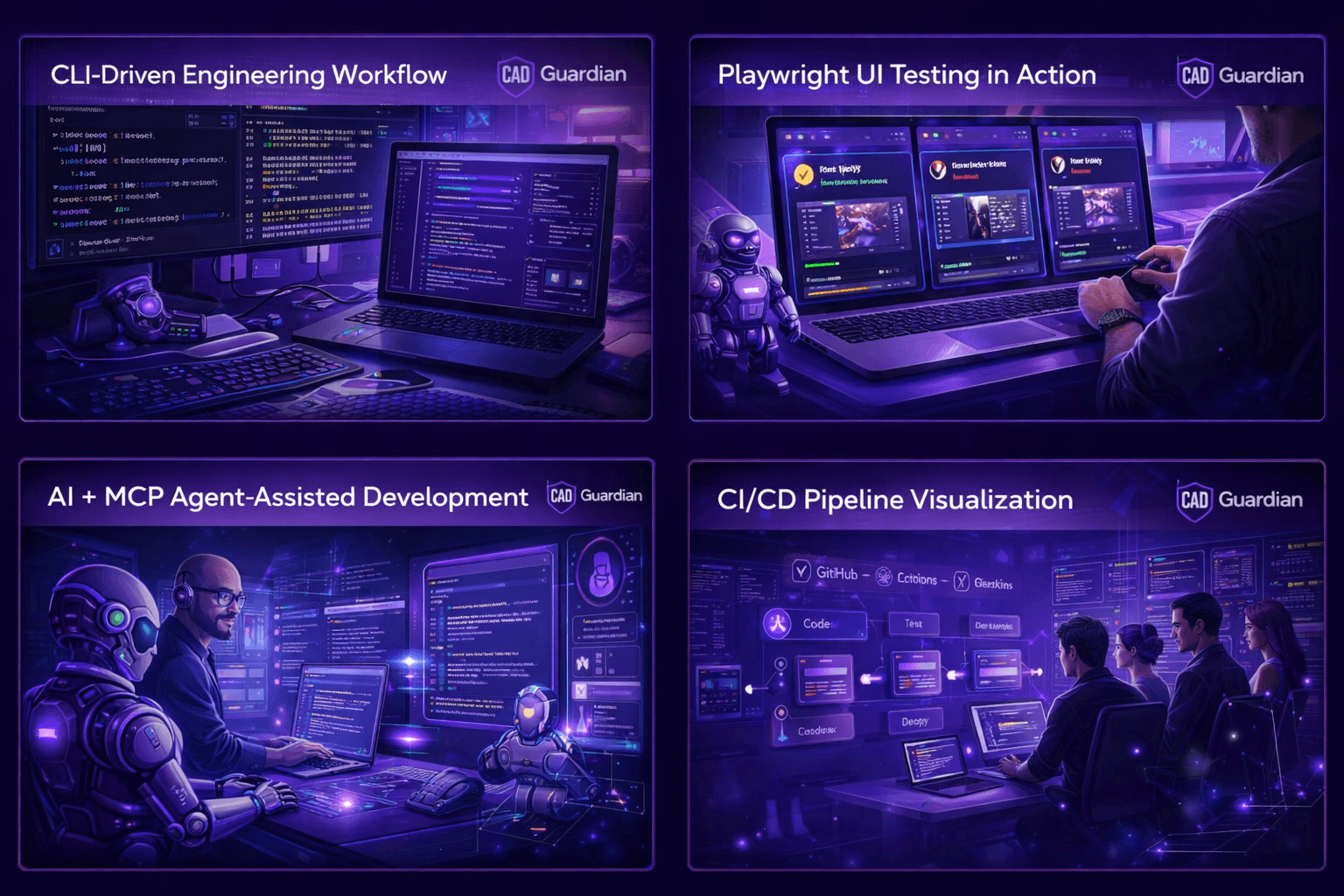
🧰 The Stack (Adopt This Exactly)
🧱 CLI Engineering Layer
Purpose: Speed + Control + Automation
GitHub CLI → https://github.com/cli/cli
Dev Containers → https://github.com/microsoft/devcontainers
Neovim (optional, high-performance workflows) → https://neovim.io
🎭 Playwright Testing Layer
Purpose: Behavior Enforcement
Docs → https://playwright.dev/
Test Intro → https://playwright.dev/docs/test-intro
🧠 MCP + AI Agents
Purpose: Context + Intelligence
🔁 CI/CD Enforcement Layer
Purpose: Zero-Trust Deployment
GitHub Actions → https://docs.github.com/en/actions
GitLab CI/CD → https://www.gitlab.com/features/ci-cd
Jenkins → https://www.jenkins.io/
🧪 Testing Strategy (Required, Not Optional)
Layer | Responsibility |
|---|---|
Unit | Validate logic |
Integration | Validate system interactions |
E2E | Validate user workflows |
Regression | Prevent reintroduced bugs |
UI Testing | Validate real behavior |
🧠 Observability + Testing Are Converging
This is where things go next:
Logs + metrics + tests unified
Failures include context automatically
Systems diagnose themselves
Tools like:
OpenTelemetry
Grafana
Datadog
…are beginning to merge into test ecosystems.
⚔️ The Cultural Problem (Especially in Enterprise + Autodesk)
The issue is not intelligence.
The issue is standards.
Many teams:
Over-index on domain knowledge
Under-invest in engineering systems
Accept manual processes as “normal”
Result:
Slower delivery
Higher defect rates
Fragile architectures
🎯 What Elite Engineers Do Differently
They:
Treat tests as infrastructure
Eliminate manual validation
Use AI to accelerate—not replace—thinking
Build systems that enforce correctness
Optimize feedback loops relentlessly
📈 Immediate Upgrade Plan (Execute This Week)
Install Playwright
Write ONE real E2E test (login, form, etc.)
Add it to CI/CD
Force a failure intentionally
Confirm deployment is blocked
If your pipeline does not stop:
👉 You don’t have a system
👉 You have a process
🔁 Midpoint Reality Check
If this feels advanced:
It’s not.
It’s just not widely adopted yet.
🧠 Future State (Where This Leads)
Within 3–5 years:
Manual QA will be largely eliminated
AI agents will maintain test suites
CI/CD pipelines will act as autonomous gatekeepers
Engineers will focus on architecture, not validation
🏁 Final Thought
The gap is no longer knowledge.
The gap is adoption speed.
The engineers who operationalize this now will:
Ship faster
Break less
Lead teams
Command higher compensation
Everyone else will still be debugging production issues manually.
📣 Call to Action
Comment “STACK” → I’ll map this to your current workflow
Comment “AUTODESK” → I’ll tailor this to Inventor/Vault ecosystems
Save this → you’ll need it when your pipeline fails