Article
Mar 19, 2026
The Compensation Secrets They Never Told You (RSUs, ISOs, ESPP) — Featuring Payroll Expert Melodie Craig
Most professionals are underpaid without realizing it. In this deep dive with payroll expert Melodie Craig, we break down RSUs, ISOs, ESPPs, bonuses, and hidden perks that separate average earners from top performers. Learn how compensation really works—and how to negotiate the full package you deserve.

💰 RSUs, ISOs, NSOs, ESPP, Pay Bands, Hidden Perks, and the System Behind Who Gets Paid What
With payroll-system perspective informed by Melodie Craig, CPP, whose background spans Paychex, ADP, Sage, Trustpoint.One, and TK Elevator
🧨 Have You Spent Your Entire Career Negotiating the Wrong Thing?
Most professionals think compensation means three things:
salary
maybe a bonus
basic benefits
That belief alone has cost people:
$20K–$80K per year in missed cash compensation
$100K–$1M+ in missed equity upside over a career
access to perks, protections, and allowances they did not know existed
leverage they never realized they had
Meanwhile, other people — sometimes with less experience, less output, or less technical range — are receiving compensation packages built very differently:
equity awards that outpace your annual raise history
signing bonuses large enough to reset personal debt or build cash reserves
retention bonuses designed specifically to keep them from leaving
allowances that quietly absorb lifestyle costs
executive-style perks not visible in standard offer language
promotion refresh grants that create wealth while others only track salary
👉 Same city
👉 Same title family
👉 Same company in many cases
👉 Completely different financial trajectory
The difference is not always intelligence.
It is often system awareness.
🧠 Compensation Is a Multi-Layer System, Not a Single Number
Every serious offer is made of multiple layers, whether the company chooses to present it clearly or not.
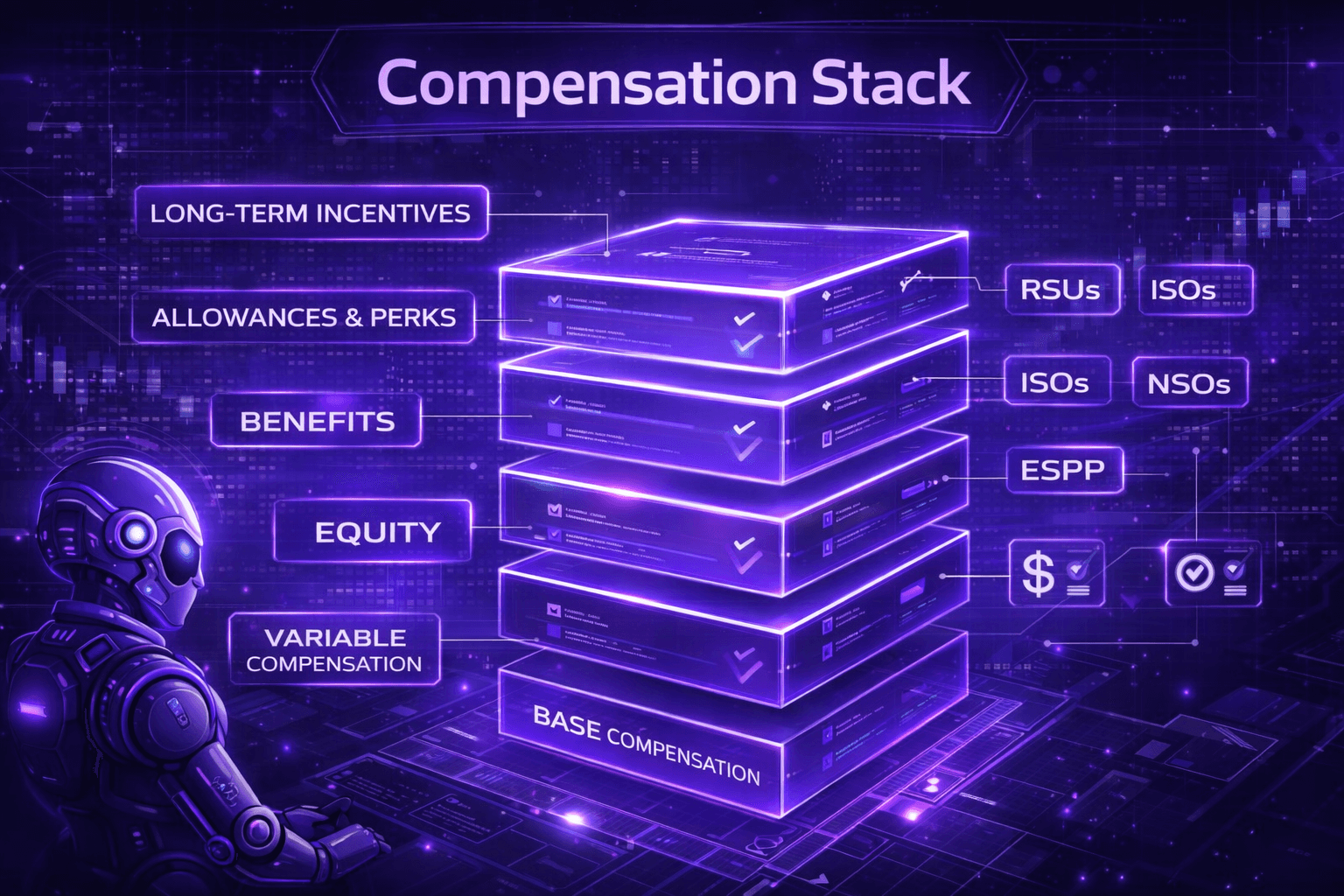
The six-layer compensation stack
Base compensation
Variable compensation
Equity compensation
Benefits and protections
Allowances and lifestyle perks
Long-term incentives
Most employees negotiate layer 1.
The people who materially change their financial lives learn how to evaluate and negotiate all six.
🧾 What Payroll Systems Actually See
This is where the public conversation about compensation often breaks down.
From an employee’s point of view, compensation can feel like a salary line and a benefits PDF.
From a payroll and systems point of view, compensation is a structured configuration of fields, codes, elections, deductions, earning types, vesting events, tax treatments, reimbursements, and eligibility logic.
Payroll-informed insight
Based on Melodie Craig’s background across Paychex, ADP, Sage, Trustpoint.One, and TK Elevator, one of the clearest realities is this:
Employees are often shown compensation in a simplified way, while the underlying systems track a much more complete picture.
What payroll systems may track that employees underweight
base pay
bonus plans
commissions
sign-on payments
retention schedules
RSU taxable events
option exercises
ESPP deductions
employer retirement contributions
taxable and non-taxable reimbursements
fringe benefits
benefit employer cost
geographic differentials
payroll tax treatment by state and jurisdiction
👉 In other words: the system often knows more about your total value than you do.
⚔️ The Truth About Compensation
Companies do not pay purely based on:
effort
loyalty
technical skill alone
how much you “deserve”
how long you stayed quiet
They pay based on a mix of:
market leverage
scarcity
internal leveling
precedent
budget timing
negotiation behavior
flight risk
business impact
whether the company believes you understand the game
If you do not know what is available, you cannot ask for it.
If you do not ask for it, you are often compared against the cheapest acceptable version of the role.

🧬 The Complete Compensation Stack
💵 1. Base Compensation — The Most Visible Lever, Not the Most Powerful
Base compensation is salary or hourly pay.
It matters. It affects your day-to-day life. It influences cash flow, budgeting, lending, and psychological safety.
But it is also the compensation component most people overestimate.
Typical broad ranges by level
Level | Typical Range |
|---|---|
Entry | $50K–$90K |
Mid | $90K–$150K |
Senior | $130K–$200K+ |
Director | $160K–$250K+ |
Executive | $200K–$500K+ |
Why base is overrated
it is taxed as ordinary income
it is constrained by band ceilings
it tends to grow linearly
it rarely creates true wealth by itself
it is often where companies want the conversation to stay
Strategic insight
Many top earners stop obsessing over maxing base once they understand that the bigger moves often come from:
bonus percentage
equity size
refresh cadence
retention structures
benefits value
promotion timing
🧾 Payroll-informed perspective on base pay
A payroll professional sees quickly that the employee who obsesses only over salary can still be materially behind another employee with the same base if that second employee has:
better variable compensation
stronger employer retirement support
equity awards
reimbursement programs
retention grants
more favorable benefit economics
That is why “I make $X salary” is often a weak proxy for actual compensation.
📈 2. Variable Compensation — Where Cash Starts to Scale
This is where compensation becomes dynamic.
Common forms
annual performance bonus
quarterly incentive bonus
spot bonus
signing bonus
retention bonus
project completion bonus
leadership multiplier
commission or quota-based variable comp
Broad ranges
individual contributor performance bonus: 5%–30%
leadership bonus: 20%–100%+
signing bonus: $2K–$100K+
retention bonus: often paid across 6–24 months
What many professionals miss
Bonuses are often treated like fixed policy when they are actually influenced by:
offer timing
urgency to hire
counteroffer risk
internal budget pressure
recruiter confidence
compensation band flexibility
Payroll-informed perspective
One payroll-relevant reality is that variable compensation shows up differently in systems and is often handled under separate earning categories, approvals, timing rules, and tax treatments. That means it is already treated internally as a distinct compensation layer — even when candidates are encouraged to focus only on salary.
🧨 Real company scenario: same role, different awareness
Employee | Base | Bonus | RSUs | Allowances | Estimated Total Comp |
|---|---|---|---|---|---|
A — accepted standard offer | $130K | 10% | $0 | $0 | $143K |
B — negotiated full package | $130K | 20% | $80K | $5K | $171K+ |
What happened?
Same role.
Same base.
The difference was not title.
The difference was packaging.
🧠 3. Equity Compensation — Where Wealth Is Actually Built
This is where the conversation becomes emotionally charged, because this is where many careers quietly split into completely different outcomes.
Some professionals spend years chasing salary increases.
Others spend those same years accumulating ownership-based upside.
That is not a small distinction.
That is often the difference between:
staying dependent on wages
building actual net worth
🟣 RSUs — Restricted Stock Units
RSUs are grants of company stock, usually expressed as a dollar value, that vest over time.
Typical structure
4-year vesting
1-year cliff in some plans
annual or quarterly vesting after cliff
refresh grants at higher levels or high-performance companies
Example
$120K RSU grant
25% vest each year over four years
Pros
no purchase required
simpler to understand than options
predictable if stock remains stable
Cons
taxed as ordinary income when vested
upside tied to company stock movement
not “free wealth” if the company underperforms
🔵 ISOs — Incentive Stock Options
ISOs give you the right to buy company shares at a fixed strike price.
Why they matter
potentially favorable tax treatment
meaningful upside if company value rises sharply
can be powerful in earlier-stage companies
Risks
you may need cash to exercise
timing mistakes can create tax complexity
options may expire worthless
🔴 NSOs — Non-Qualified Stock Options
NSOs function similarly to ISOs in many practical ways, but the tax treatment is generally less favorable.
Why people misunderstand NSOs
Many candidates hear “options” and assume that means meaningful upside. It can. But the value depends on:
grant size
strike price
company growth
liquidity event
exercise strategy
taxation at exercise
🟡 ESPP — Employee Stock Purchase Plan
ESPPs allow employees to buy company stock, often at a discount such as 10–15%.
Why it matters
For many workers, this is one of the most overlooked wealth tools in the entire employment package.
Why it’s powerful
built-in discount
potential lookback features
regular wealth accumulation via payroll deductions
can create low-friction upside if used carefully
⚡ What most people do not realize about equity
Equity determines whether many professionals:
stay on a wage treadmill
or participate in enterprise upside
The outcome depends on:
grant size
timing
company performance
refreshes
vesting patience
whether you even understood what was offered
🧾 Payroll-informed perspective on equity
A payroll professional also understands something many employees do not: equity is not just “finance stuff.” It has payroll and tax implications.
That means equity events may affect:
taxable wages
withholding
paycheck surprises
year-end tax documents
planning around vesting and exercise events
This is one reason people feel blindsided by equity: they were sold the upside, but never taught the mechanics.
🔵 Real company scenario: hidden equity gap
Category | Package 1 | Package 2 |
|---|---|---|
Base | $110K | $110K |
Bonus | 10% | 15% |
RSUs | $20K | $100K |
ESPP | No | Yes |
Outcome
Employee 1 thinks they accepted a good salary.
Employee 2 accepted a compensation strategy.
🏥 4. Benefits — Hidden Compensation Most People Undervalue
Benefits are not fluffy extras. They are compensation.
Core benefits
health insurance
dental
vision
life insurance
disability coverage
401(k) match
Advanced benefits
HSA contributions
fertility support
mental health coverage
legal plans
dependent care support
adoption assistance
tuition reimbursement
backup child care
wellness spend
Real value
Depending on level, company, geography, and family situation, benefits can easily represent:
$10K–$40K+ per year
Sometimes much more.
🧾 Payroll-informed perspective on benefits
This is another place where the employee’s mental model is too small.
Employees often think:
“I have insurance.”
The company and payroll systems think in terms of:
employer premium share
pretax deduction structure
match formulas
taxable fringe valuation
benefit eligibility class
plan design economics
That difference matters because it affects how much real compensation you are receiving — and how portable or costly it becomes if you leave.
🎁 5. Allowances and Hidden Perks — The Blind Spot
This is where many professionals realize, sometimes painfully late, how much they never thought to ask about.
Common allowances
home office stipend
phone reimbursement
internet reimbursement
meal allowances
commuting support
relocation support
professional development budget
certification reimbursement
conference travel
Advanced or higher-band perks
housing allowance
executive assistant support
discretionary travel budget
club membership
enhanced wellness budget
tax preparation assistance
financial planning access
vehicle allowance
Unknown-to-many category: discretionary spend
Some roles quietly carry informal or semi-formal access to:
relationship-building budgets
vendor entertainment budgets
leadership event budgets
external networking spend
flexible reimbursement categories
These do not always appear as glamorous line items in an offer letter, but they can materially shape lifestyle, exposure, and influence.
🧾 Payroll-informed perspective on hidden comp
One of the most important payroll-adjacent truths is that some compensation components are not automatically surfaced equally to everyone. Certain items become visible only when:
the candidate asks
the manager advocates
the company needs the hire badly
the employee is viewed as retention-sensitive
That means silence is expensive.
🧱 6. Long-Term Incentives — Where Many People Lose the Most Money
This is one of the most painful categories because people often lose money here without realizing it until later.
Components
vesting schedules
cliffs
refresh grants
milestone bonuses
promotion resets
multi-year retention payouts
deferred cash incentives
Common mistake
People leave a company:
just before a major vest
just before a refresh cycle
just before a retention trigger
just before a bonus eligibility date
Cost
That mistake can quietly cost:
$20K
$50K
$150K
$300K+
without ever being labeled as a “loss” in the mind of the employee
🔴 Real company scenario: exit timing
Scenario | Outcome |
|---|---|
Leaves at 3.5 years | misses final major vest |
Stays through full cycle | captures full grant |
Financial consequence
A departure decision that feels emotionally urgent can become a six-figure wealth decision.

🧠 Compensation by Level — How the Stack Changes Across Bands
🟢 Entry-Level
Typical pattern
base-heavy
minimal or no equity
smaller bonuses
fewer discretionary perks
Most realistic levers
signing bonus
certification support
relocation
equipment stipend
growth-path clarity
🔵 Mid-Level
Typical pattern
stronger base
annual bonus begins to matter
equity may start appearing
more leverage if skills are marketable
Key opportunity
This is where many people either remain salary-only thinkers or begin learning how real compensation works.
🟣 Senior / Lead
Typical pattern
meaningful bonus percentage
equity more material
retention risk becomes relevant
benefit value matters more due to family/life structure
Key opportunity
Negotiate the full stack, not just salary adjustment.
🔴 Director / Architect
Typical pattern
bonus and equity become major components
executive-style perks begin appearing
long-term incentives become more strategic
negotiation becomes more individualized
Example structure
Component | Value |
|---|---|
Base | $185K |
Bonus | 30% ($55K) |
RSUs | $150K |
Retention Bonus | $50K |
Estimated total comp: $440K+
🟡 Executive / VP+
Typical pattern
compensation becomes an engineered system
equity dominates
bonus structure becomes major
exit terms and change-in-control provisions matter
allowances and executive protections expand
At this level, “salary” is often the least interesting part of the package.
🧠 Inside the System — Payroll Perspective Informed by Melodie Craig’s Background
Melodie Craig’s career background spans:
Paychex
ADP
Sage
Trustpoint.One
TK Elevator
real estate brokerage exposure
payroll tax and billing functions
enterprise and SMB contexts
That matters because it means the lens here is not theoretical. It comes from environments where compensation is not just discussed — it is configured, processed, classified, taxed, reconciled, and corrected.
Payroll-informed insight 1
Employees often focus on the number they can see most clearly: base pay.
Systems and payroll operations track a much broader compensation picture.
Payroll-informed insight 2
Two employees with the same title can carry very different compensation profiles depending on what was negotiated, what the company approved, and how the package was configured internally.
Payroll-informed insight 3
The largest silent losses are often not low salaries — they are missed vesting, misunderstood incentive structures, unclaimed allowances, and under-negotiated packages.
Payroll-informed insight 4
A compensation package is not just an HR conversation. It becomes a system reality — across payroll, tax, benefits, and reporting.
📊 Framer-Ready Tables You Can Bolt In
Full-stack compensation example
Layer | Component | Typical Value |
|---|---|---|
Base | Salary | $120K |
Variable | Bonus (15%) | $18K |
Equity | RSUs | $60K |
Benefits | Insurance + 401(k) support | $20K |
Allowances | Stipends | $3K |
Long-Term | Retention | $25K |
Perceived pay vs actual comp
Perceived: $120K
Actual total compensation: $246K
Equity impact over time
Year | RSU Value | Cumulative Value |
|---|---|---|
Year 1 | $15K | $15K |
Year 2 | $15K | $30K |
Year 3 | $15K | $45K |
Year 4 | $15K | $60K |
Why this matters
Most people think in year-one terms and make year-three mistakes.
Compensation awareness gap
Awareness Level | Typical Behavior | Typical Outcome |
|---|---|---|
Low | accepts the first offer framing | underpaid |
Medium | negotiates base salary only | modest gain |
High | negotiates the full stack | materially improved outcome |
🔧 If You Don’t Know This Space, Start Here
Compensation data
Levels.fyi
Glassdoor
Payscale
Equity education
Investopedia: RSU
Investopedia: ISO
Investopedia: NSO
Investopedia: ESPP
Offer comparison tools
Levels offer tool
Candor
Negotiation strategy
Patrick McKenzie salary negotiation guide
Haseeb Qureshi offer negotiation guide
Benefits and policy benchmarking
U.S. Bureau of Labor Statistics Employee Benefits Survey
SHRM
🚨 Read This Slowly
There are people:
in your city
with your title
with less output
with weaker communication
with less business impact
making:
2x–5x your compensation
Not because they are always better.
Because they understood the system earlier.
⚡ If This Is Hitting You Right Now
You are not behind because you are incapable.
You are behind because most people are taught to negotiate the visible part of compensation and ignore the engineered part.
That is not a personal failure.
But once you see it, it becomes a strategic responsibility.
🎯 Immediate Action Plan
Before your next offer, ask for the complete compensation picture:
What is the base salary?
What variable compensation exists?
What bonus percentage is target and what drives payout?
What equity is included?
What type of equity is it?
What is the vesting schedule?
Are there refresh grants?
Is there an ESPP?
What benefits are employer-funded?
What allowances or reimbursements are available?
Is there a retention structure?
Are there geographic or level-based perks?
If they hesitate, get vague, or keep redirecting you back to salary:
👉 that is often where the hidden value is
🏁 Final Thought
The difference between a $90K employee mindset and a $250K+ total compensation strategy is not always technical skill.
It is often:
awareness
framing
timing
positioning
negotiation
patience
system literacy
The system already knows your value in more dimensions than most workers ever ask about.
The real question is whether you are finally going to learn to see it too.
📣 CTA
Comment COMP if you want a compensation breakdown framework.
Comment LEVEL if you want help identifying which band you should really be targeting.
Comment PAYROLL if you want a follow-up article focused specifically on how payroll systems, taxes, and compensation structures interact.
Save this.
Because once you understand compensation as a stack, you stop negotiating like an employee looking for approval and start negotiating like someone who understands enterprise value.