Article
Mar 19, 2026
Frontier CAD for the Next 3 Years
CAD is evolving from drafting to systems engineering. This guide breaks down the frontier tools, AI workflows, automation frameworks, and career paths reshaping mechanical, civil, electrical, construction, and manufacturing design. Learn how to move beyond drawings into high-leverage, high-impact roles—and stay ahead of where the industry is going.
Frontier CAD for the Next 3 Years
The tools, frameworks, principles, and career moves that separate CAD operators from CAD leaders
Most CAD professionals were trained for a world where speed meant hotkeys, layer discipline, and fewer clicks.
That world is still here. It is just no longer the whole game.
The frontier of CAD now sits at the intersection of AI-assisted design, model-based definition, cloud-native collaboration, design automation, reality capture, open standards, and digital twins. Autodesk is pushing AI-driven early-stage analysis in Forma and generative design in Fusion; Inventor is leaning harder into model-based definition; APS is explicitly positioning itself as infrastructure for AI, agentic workflows, dashboards, digital twins, and enterprise integrations; Civil 3D continues to push automation, interoperability, and reusable scripting through Dynamo; ReCap keeps reality-capture workflows in the mainstream; and outside Autodesk, Onshape, Bentley, OpenUSD, IFC, and Omniverse are all moving the market toward more connected, simulation-ready, interoperable 3D ecosystems. (Autodesk)
That matters because the market is not rewarding “CAD person who draws faster” the way it once did. U.S. architecture and engineering occupations overall are projected to grow faster than average from 2024 to 2034, with about 186,500 openings per year and a median wage of $97,310 in May 2024. But the broader drafters category is projected to show little or no change, even though there will still be about 16,200 openings per year from replacement demand. The implication is blunt: pure drafting remains necessary, but higher leverage sits closer to engineering, automation, digital delivery, and operations. (Bureau of Labor Statistics)
What “frontier,” “emerging,” and “bleeding edge” actually mean
Frontier tools are already usable in production and create measurable leverage now.
Emerging tools are stable enough to pilot, but not mature enough to standardize everywhere.
Bleeding edge tools can create unfair advantage, but they also carry workflow risk, training cost, or interoperability uncertainty.
That distinction matters. Your CAD Guardian audience does not need hype. They need a map.
The new CAD stack
1. AI-native design assistance
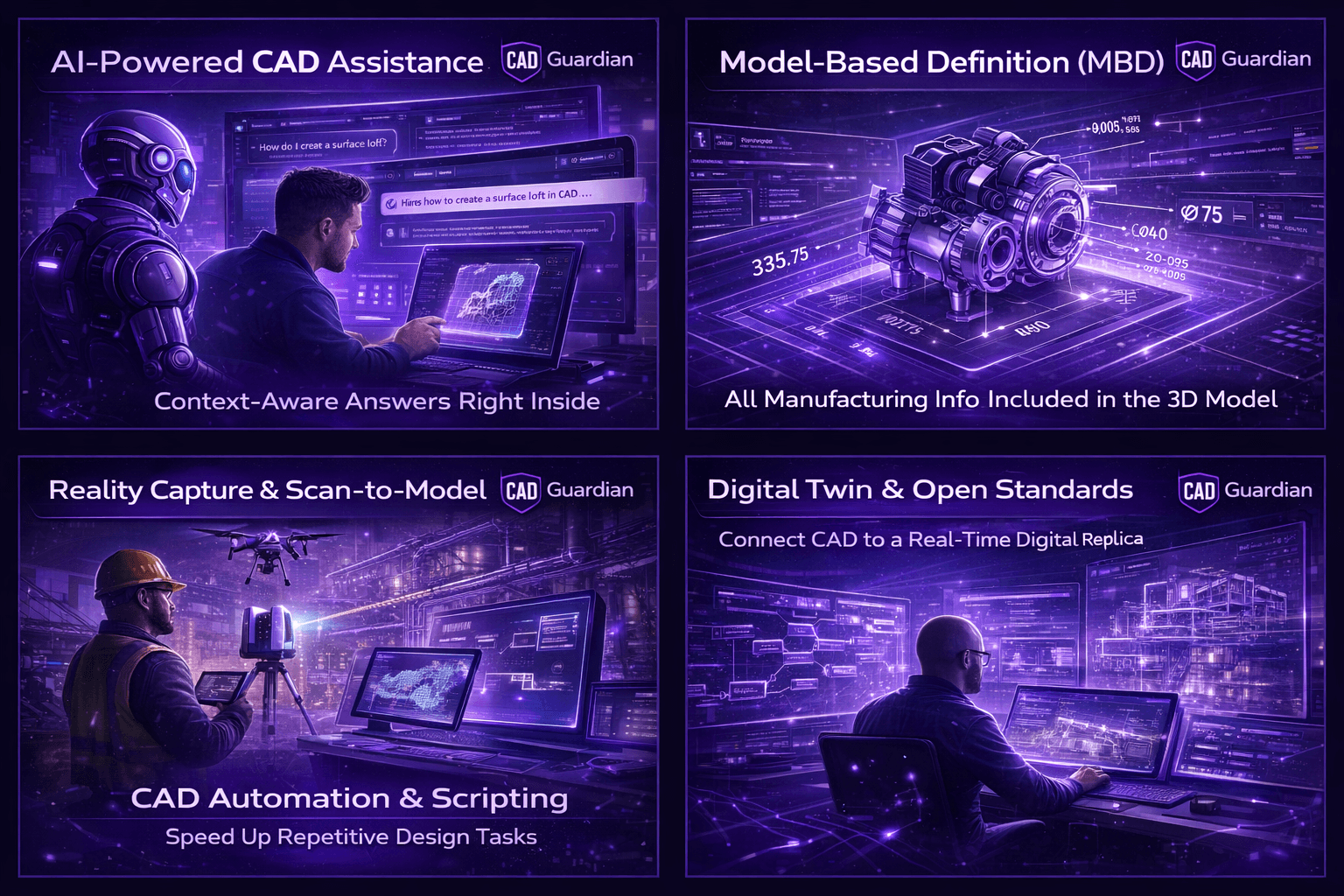
This is no longer just “chatbot glued onto software.” Onshape’s AI Advisor is context-aware, lives inside the CAD workspace, and can answer questions about surfacing, drawings, and other features directly in the tool. Autodesk Forma is pushing real-time AI analyses for wind, noise, embodied carbon, and related early-stage context. Fusion’s generative design stack is explicitly built around AI-driven exploration of outcomes under manufacturing and performance constraints. (onshape.com)
The practical meaning for your audience is simple: the next-generation CAD professional will not just model geometry. They will set up constraints, ask better questions, compare generated options, and make the final judgment.
2. Model-based definition is moving from “nice idea” to core workflow
Inventor positions MBD as embedding manufacturing information directly in the 3D model, and Onshape’s 2026 updates marked MBD as a major milestone for communicating manufacturing intent directly inside the model. This is one of the clearest signs that the center of gravity is shifting from 2D drawings as the sole authority toward richer 3D product definitions. (Autodesk)
For CAD Guardian, this is one of the highest-signal themes in the market: the more downstream data you can encode once, the fewer times humans have to reinterpret it later.
3. Automation is now part of the authoring environment, not a side hobby
APS says its APIs and services are for building dashboards, digital twins, enterprise integrations, and AI-enabled workflows, and it explicitly says APS supports AI, generative AI, agentic systems, and MCP-style application building. Civil 3D’s current feature stack keeps emphasizing Dynamo for reusable scripts and automation of repetitive tasks, while Autodesk University materials continue to frame Dynamo as the bridge between authoring tools and deeper API-based automation. (Autodesk)
The strategic takeaway is that the frontier CAD professional is becoming part designer, part rules author, part systems thinker.
4. Reality capture is no longer optional for serious field-to-model workflows
ReCap Pro is explicitly for creating 3D models from photos and laser scans, and Autodesk says drone or laser-scan capture can gather site data in hours. Civil 3D and ReCap are increasingly framed as connected in roadway, site, and infrastructure workflows. (Autodesk)
That makes reality capture a career accelerant for civil, construction, industrial retrofit, plant, and brownfield work. The future is not “draft from scratch and hope field conditions match.” The future is capture, register, compare, and design against reality.
5. Open standards are becoming career leverage, not just IT talking points
buildingSMART states that the latest official IFC version is 4.3.2.0, published as ISO 16739-1, with IFC 5 in development. Meanwhile, the Alliance for OpenUSD says Core Specification 1.0 is now established, and NVIDIA is explicitly framing Omniverse plus CAD-to-USD workflows as the path to simulation-ready, AI-ready physical design pipelines. (buildingSMART International)
This is not abstract. It means the professionals who understand IFC, USD, data exchange, and model portability will outperform those who stay trapped inside one authoring environment.
6. Digital twins are turning CAD from documentation into operations infrastructure
Bentley’s iTwin platform is positioned as the foundation for SaaS and bespoke apps that design, build, and operate infrastructure assets, handling data integration, visualization, change tracking, and security. NVIDIA Omniverse is aimed at industrial digitalization. APS is positioned for dashboards, twins, and connected design-and-make data. (Bentley Systems)
That changes the identity of CAD work. In the old model, CAD ended at issue-for-construction. In the new model, CAD becomes a node in a living operational graph.

What matters by discipline
Mechanical
Mechanical professionals should care most about Inventor, Fusion generative design, MBD, Onshape AI assistance, and CAD automation. Inventor already combines parametric, direct, freeform, rules-based design, machine design, sheet metal, frame, tube-and-pipe, cable-and-harness, and MBD. Fusion’s generative design expands option exploration under manufacturing constraints. Onshape’s AI Advisor and MBD push cloud-native learning and manufacturing intent closer together. (Autodesk)
The frontier mechanical drafter is moving toward design systems, not isolated parts. They are stronger when they can encode design intent, automate reuse, and cut redraws between engineering and manufacturing.
Piping / process / plant
For piping and process work, Plant 3D, P&ID discipline, orthos/isometrics automation, and Construction Cloud-linked workflows are the real leverage points. Autodesk’s Plant 3D toolset can extract orthographic drawings directly from the 3D model, update them as the model changes, and generate industry-standard or project-standard piping isometrics directly from the model. Autodesk also continues to position P&ID as core to industrial process documentation. (Autodesk)
That means the biggest win is not “draw faster pipe.” It is eliminate duplicate documentation effort and keep documents synchronized with the model.
Civil / land / transportation / water
Civil 3D remains central here, but the frontier layer is broader: Dynamo, grading optimization, geotechnical modeling, IFC exchange, Esri-connected context, project-explorer validation, and ACC/Civil Tools collaboration. Civil 3D explicitly supports automation of repetitive and complex tasks through Dynamo, dynamic corridor workflows, utilities design, storm and sanitary analysis, plan production, and interoperability including IFC import/export. Autodesk also frames Civil Tools in Docs as a way to keep design review from collapsing back into authoring software. (Autodesk)
For civil audiences, the opportunity is not just drafting alignments. It is becoming the person who can connect survey, analysis, automation, review, quantity takeoff, and digital delivery into one repeatable pipeline.
Electrical / controls
AutoCAD Electrical is one of the clearest examples of targeted time savings. Autodesk says the Electrical toolset can boost productivity by up to 95%, with 65,000+ intelligent symbols, automated wire numbering, automated component tags, and automatic report generation. Autodesk University materials also emphasize its linked behavior across schematics, panel layouts, and related diagrams. (Autodesk)
The signal here is strong: electrical drafting becomes more valuable when it is data-aware, standards-aware, and output-aware, not just symbol placement.
Construction / VDC / BIM coordination
Construction-oriented CAD professionals should watch Forma, ACC, ReCap, IFC, and digital twins. Forma is moving AI into early-stage planning and board-based review; ACC is the “single source of truth” platform language Autodesk is pushing; ReCap brings the site back into the model; IFC remains the core interoperability standard for many project exchanges. (Autodesk)
This is where CAD shifts from “draw package producer” to decision-support operator.
Industrial / manufacturing / continuous improvement / process improvement
This group has one of the biggest upside curves. BLS projects industrial engineers at 11% growth from 2024 to 2034, much faster than average, with about 25,200 openings per year. That matters because the frontier of industrial work is deeply connected to layout optimization, automation, simulation, digital twins, MBD, and operational data feedback loops. (Bureau of Labor Statistics)
For your audience, this is a major message: if they understand plant layouts, workcells, constraints, takt, changeovers, BOM/MBOM handoff, and automation, they can move from “CAD support” into throughput architecture.
The biggest time-saving principles
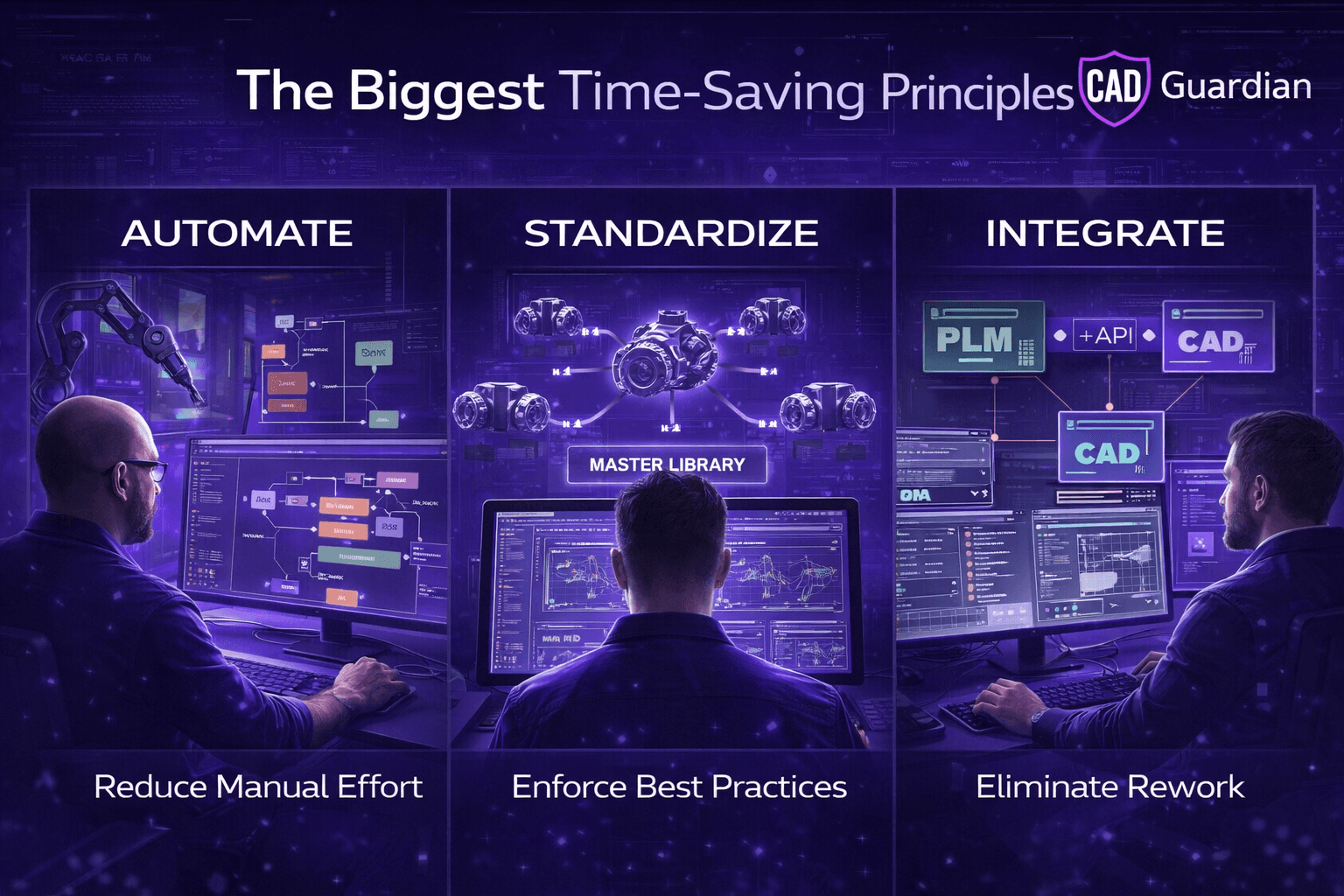
The market keeps changing tools, but the time-saving principles are stable.
Principle 1: Author once, reuse everywhere
MBD, intelligent symbols, parametric assemblies, automated isos, and reusable Dynamo graphs all reduce repeated interpretation. (Autodesk)
Principle 2: Push intelligence upstream
Forma’s early AI analyses, Fusion’s generative exploration, and grading optimization in Civil 3D all point to the same principle: bad options are cheaper to kill early. (Autodesk)
Principle 3: Automate the repetitive, not the judgment
Dynamo, APS automation, and Electrical/Plant automation are strongest where standards and repetition dominate. The high-value human work stays in constraint setting, tradeoff evaluation, and exception handling. (Autodesk)
Principle 4: Draft against reality, not assumption
Reality capture and connected field data reduce redraw loops and late-stage surprises. (Autodesk)
Principle 5: Build for interoperability
IFC, OpenUSD, and CAD-to-USD workflows matter because isolated models are becoming weaker strategic assets than connected ones. (buildingSMART International)
The career map CAD Guardian should own
The uncomfortable truth is that “drafter” by itself is no longer the ceiling role to optimize for. The better move is to treat drafting as the foundation and then climb into one or more of these lanes:
CAD automation developer
computational designer
BIM/VDC automation specialist
civil design automation lead
digital twin implementation specialist
manufacturing design systems engineer
plant data / digital delivery lead
design-to-manufacturing integration architect
APS / API workflow developer
reality-capture-to-model specialist
That direction matches the labor signal. Drafters still have thousands of openings, but the faster-growth and higher-leverage adjacent lanes sit in engineering, industrial systems, civil delivery, and construction operations. Civil engineers are projected at 5% growth with about 23,600 openings annually; electricians are projected at 9% growth with about 81,000 openings annually; industrial engineers are projected at 11% growth. (Bureau of Labor Statistics)
What you should "they" do next
If they are mechanical, they should master Inventor/Fusion, MBD, parametrics, and automation.
If they are piping/process, they should own Plant 3D, P&ID logic, specs/catalogs, and automatic documentation.
If they are civil, they should learn Civil 3D automation, quantity workflows, ACC review, and open-format exchange.
If they are electrical, they should move beyond drafting into automated numbering, reporting, panel logic, and standards-based output.
If they are construction/VDC, they should understand Forma, ACC, ReCap, IFC, and model-to-field coordination.
If they are industrial/continuous improvement/manufacturing, they should combine CAD with throughput, data, layout logic, and digital-twin thinking.
Final position
Your strongest authority position is not “I know CAD software.”
It is this:
I understand where CAD is going, what will matter by discipline, and how to convert drafting skill into systems leverage.
That is the message that makes your audience feel they belong.
Not because they know every tool already.
Because they can see the path.
And the path is clear:
from drawing to data
from geometry to logic
from files to systems
from drafting to architecture
from operator to authority