Article
Mar 6, 2026
From CAD to Systems Thinking: A Lesson from Chander Dhall on Observing Software in Motion
A simple moment during a technical call revealed a powerful engineering habit: watching system behavior while software runs. Inspired by Chander Dhall, this article shows CAD drafters, BIM professionals, and Autodesk Construction Cloud leaders how observability—CPU, memory, and runtime metrics—transforms development into true systems architecture. 🚀
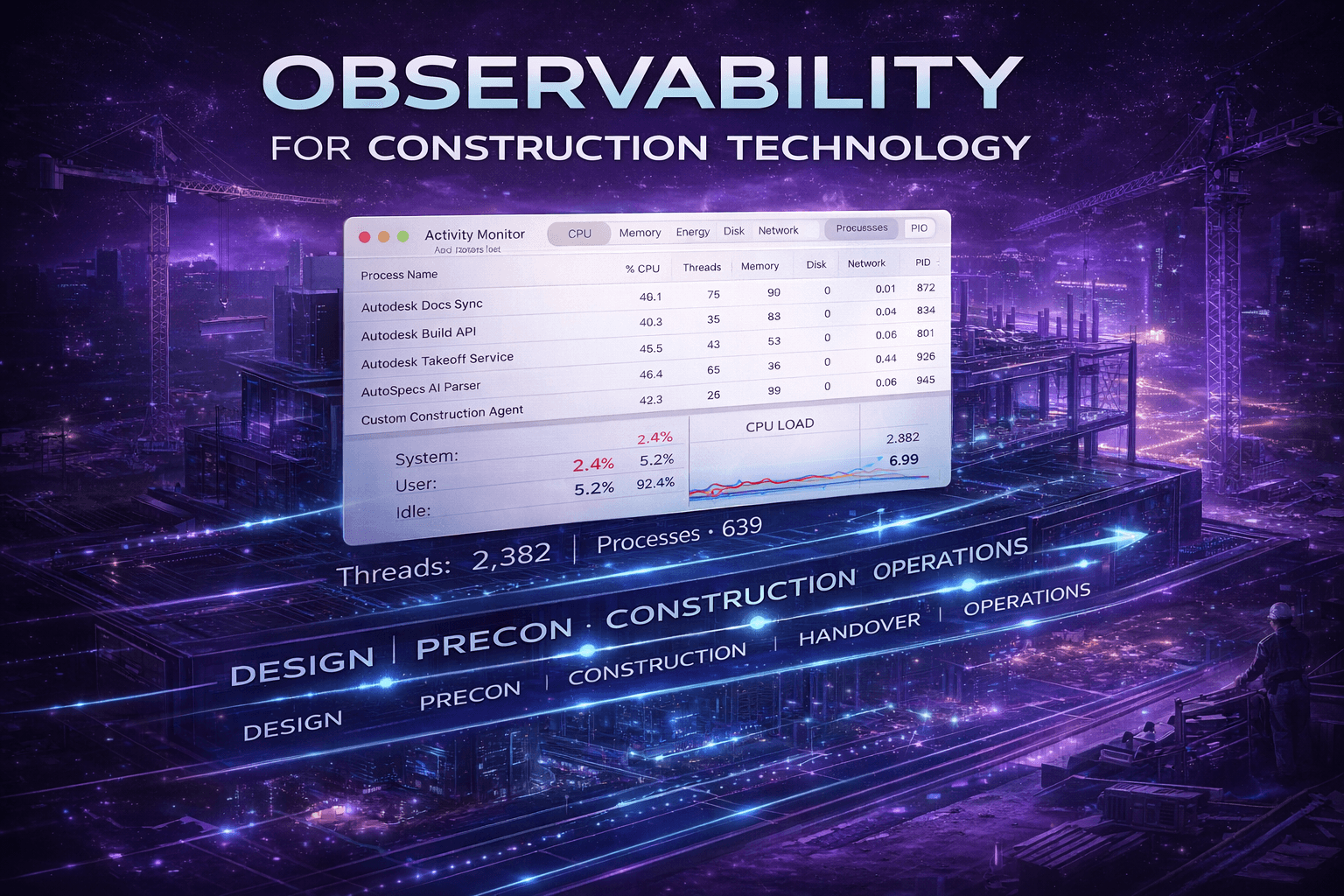
The Moment I Realized I Was Missing a Layer of Engineering
During a technical call with Chander Dhall, something subtle happened that completely shifted my perspective on software development.
He was demoing an application while speaking about architecture and system behavior. But while the application ran, his attention kept moving to another window: macOS Activity Monitor.
Not the code.
Not the UI.
The runtime behavior of the system itself.
At that moment I realized something important:
I had been thinking like a software developer.
He was thinking like a systems architect.
And for professionals working in Autodesk Construction Cloud, BIM environments, and large-scale design systems, that distinction matters more than most people realize.
A Lesson for the AEC Technology Community
Many professionals in the Architecture, Engineering, and Construction (AEC) industry are becoming increasingly technical.
Roles such as:
CAD Drafter
BIM Coordinator
Design Engineer
Construction Technology Manager
Autodesk Construction Cloud Solution Architect
now operate inside ecosystems of:
cloud platforms
APIs
data pipelines
automation scripts
AI agents
Yet there is one engineering mindset that often gets overlooked.
Observability.
Observability means understanding what your system is doing while it runs.
Not just whether a feature works.
What Observability Looks Like in Practice
When Chander referenced Activity Monitor during the demo, he was watching four critical signals:
Signal | What it reveals |
CPU | computational workload |
Memory | object lifecycle and leaks |
Threads | concurrency behavior |
Idle wakeups | inefficient polling or loops |
Experienced architects observe these metrics constantly because software is not static.
It is a living system.
And every system consumes physical resources.
Why This Matters in Autodesk Workflows
Many professionals using Autodesk platforms think primarily about:
drawings
models
coordination
clash detection
document management
But under the surface, modern AEC environments involve massive computational workloads.
Examples include:
Model Coordination
Large federated BIM models can include:
millions of objects
multi-disciplinary geometry
high-frequency clash detection
Design Collaboration
Cloud-based collaboration requires:
version control
model differencing
file synchronization
distributed compute
Construction Intelligence
Platforms like Autodesk Construction Cloud process:
takeoffs
schedule simulations
cost forecasting
project analytics
These operations place real load on systems.
And the engineers designing these solutions must understand their behavior in real time.
The Four Layers of Professional Observability
Professional software architects typically operate across four layers of system visibility.
1. System Layer
Tools like Activity Monitor or system monitors show:
CPU usage
RAM consumption
thread count
disk activity
This answers a simple question:
Is the system healthy while running my application?
2. Application Layer
Logs and telemetry reveal:
API calls
errors
performance delays
resource spikes
This is where tools like:
OpenTelemetry
Prometheus
Grafana
become essential in enterprise systems.
3. Code Layer
Profilers examine what individual functions are doing.
For example:
inefficient loops
memory allocation spikes
recursive calls
blocking operations
4. Architecture Layer
This is where solution architects operate.
They observe patterns such as:
system scaling behavior
distributed workloads
cloud compute utilization
data pipeline efficiency
This level is critical for large platforms like Autodesk Construction Cloud.
The Hidden Gap in Many CAD and BIM Teams
In my experience working with CAD teams and automation systems, most professionals operate in this loop:
write script
run script
see output
But elite engineering teams operate differently:
run system
observe behavior
analyze metrics
optimize architecture
The difference is subtle but powerful.
It transforms development from trial-and-error coding into engineering discipline.
What This Means for CAD Drafters and Designers
You do not need to become a full-time software engineer to benefit from this mindset.
But you should start thinking about your tools differently.
When working with automation scripts, BIM integrations, or design software:
Ask questions like:
Is this workflow consuming too much CPU?
Are large models causing memory spikes?
Is a plugin creating unnecessary background processes?
Are scripts running inefficient loops?
Even basic monitoring can reveal hidden problems.
The Future of Construction Technology
As AEC technology evolves, the industry will see more professionals who combine:
design expertise
software engineering
cloud architecture
data analytics
These hybrid roles already exist:
BIM DevOps Engineers
Construction Technology Architects
Digital Twin Platform Engineers
Autodesk Platform Solution Architects
Understanding runtime behavior will become a core skill.
A Final Takeaway
What looked like a small action during a call was actually a signal of deep experience.
While many engineers focus only on the interface, experienced architects watch the entire machine.
CPU.
Memory.
Threads.
Load.
Because real systems are not just code.
They are living architectures.
And learning to observe them is the moment when someone stops being just a developer and starts becoming a systems thinker.
About the Inspiration
This reflection was inspired by a discussion with Chander Dhall, a globally recognized technology leader, Microsoft AI MVP, and founder of Cazton, known for architecting scalable enterprise systems across cloud, AI, and distributed platforms.
His work has influenced large organizations worldwide and helped shape modern approaches to scalable software architecture and AI-driven systems.
Author
Thomas Smith
Founder — CAD Guardian
Helping engineers, designers, and architects bridge the gap between CAD workflows and modern software architecture.